Showing posts with label unconstitutional. Show all posts

Friday, August 22, 2008

Wild Denver: Clinton Backer Files to Disqualify Obama


Your Ad Here


Fight

Can anyone say "Clintons"?

Saw this at Atlas Shrugged (via Memeorandum):

This just in from Hannity's blog (hat tip Rise Up) from here: Obama Sued in Philadelphia Federal Court on Grounds he is Constitutionally Ineligible for the Presidency

A prominent Philadelphia attorney and Hillary Clinton supporter filed suit this afternoon in the U.S. District Court for the Eastern District of Pennsylvania against Illinois Sen. Barack Obama and the Democratic National Committee. The action seeks an injunction preventing the senator from continuing his candidacy and a court order enjoining the DNC from nominating him next week, all on grounds that Sen. Obama is constitutionally ineligible to run for and hold the office of President of the United States.

Phillip Berg, the filing attorney, is a former gubernatorial and senatorial candidate, former chair of the Democratic Party in Montgomery (PA) County, former member of the Democratic State Committee, and former Deputy Attorney General of Pennsylvania. According to Berg, he filed the suit--just days before the DNC is to hold its nominating convention in Denver--for the health of the Democratic Party.

"I filed this action at this time," Berg stated, "to avoid the obvious problems that will occur when the Republican Party raises these issues after Obama is nominated.".

More: The Art of War - the Clintonostra file suit to remove Barack Obama from the ballot

Hold onto your hats!

Denver's gonna get wild in the summertime!

by mondoreb

Monday, March 3, 2008

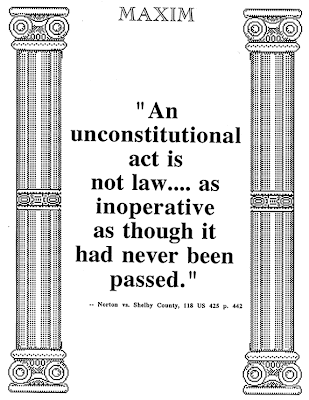
Virginia Supreme Court Rules Legislature Cannot Delegate Taxing Power to Non-elected Bodies


Finally.

A blow is struck against the increasing authority granted to non-elected officials and bodies. The Virginia Supreme Court struck a blow for the Constitution.

At least for citizens of Virginia.

The Virginia Supreme Court dealt a crippling blow to the region’s transportation plans on Friday when it ruled that the General Assembly cannot delegate taxing power to nonelected bodies.

The ruling means that the seven taxes and fees the Hampton Roads Transportation Authority had planned to impose in May to finance about $9 billion in road projects cannot be collected.

Because it did not strike down the state’s right to create it, the high court left open the possibility that the authority could survive. But the court placed responsibility for raising revenue to finance the road projects squarely on the shoulders of state legislators.

The unanimous ruling hit the General Assembly like a bomb, leaving lawmakers in Richmond dazed about what to do on the complex and politically charged issue of transportation.

The story typically interviews the one person most sympathetic to hitting the public with additional taxes: the director of the agency that would have received the taxpayers' money.
Art Collins, acting executive director of the Hampton Roads Transportation Authority, characterized the ruling in stark terms.

“We just went back 12 years,” he said. “We have no valid transportation plan now. It is just nuclear – that’s the only way to describe it. There is no reading between the lines. They said you can’t do it.”

The legislature in Virginia appears no different than lawmakers elsewhere.

They want to create "feel-good" programs with other people's money--but don't want to take the responsibility of paying for them. The election year charge of "He raised your taxes!" is not one incumbents want to hear.

So they dish the details off to non-elected groups: authorities, commissions, etc.
Many Democratic lawmakers said the ruling was a repudiation of the House Republican leadership, which had sponsored the road bill last year that left the decision about raising taxes and fees in the hands of the regional authorities.

Upon learning of the decision, Del. Lionell Spruill Sr., D-Chesapeake, uttered a triumphant “Yes!”

“First of all, I didn’t vote for it anyway,” Spruill said. “My question is, 'How can a city tax another city?’ So I was right. I voted against it because it’s not right for a group of cities to form an authority to tax another city.”

The reporter for the story interviewed another person who stood to gain from the now-unconstitutional plan: the transportation authority's chairman.
Norfolk Mayor Paul Fraim, the authority’s chairman, said he plans to meet with Kaine on Monday to discuss the region’s next move.

“It’s a setback,” Fraim said.

Opponents of the authority, who have long argued it was constitutionally dubious, rejoiced, saying the high court supported their long struggle to force lawmakers to ask all Virginians, not just the large metropolitan regions, to pay for road improvements.

“We are ecstatic about it,” said Robert Dean, head of the Virginia Beach Taxpayer Alliance, which supported the suit against the authorities.

What do non-elected bodies do when they receive an influx of taxpayer funds?

Put people on the payroll, naturally.
The authority, which is in the process of hiring staff, has already approved a $497 million plan that includes $50 million a year for Washington’s Metro system, $25 million a year for the Virginia Regional Express, and numerous road projects.

The Virginia Supreme Court has ruled non-elected bodies can't levy taxes.

The American Revolution was fought over just such an issue: no taxation without representation. That principle has been diluted over the years as elected bodies delegate all manner of power to non-elected officials.

If the public disagrees, they have no where to turn: they can't vote non-elected officials out of office.

Now, if only next the attention turns to unelected Smoke and Health Nazis. Anti-smoking fines and jail terms are being pronounced, in many cases, by unelected health group officials throughout the nation.

Rome wasn't built in a day.

by Mondoreb
hat tip: Michael Wagner Freedom Phoenix
image: libertygunrights
Source: Regional Transportation Authorities Ruled Unconstitutional

Digg!


Death by 1000 Papercuts Front Page.
Wednesday, December 5, 2007

Court Considers Another Offended Atheist's Plea For Justice in "Nation Under God"


Man in is Black offended, is not atheist


California: beaches, Silicon Valley, Valley Girls.

And offended atheists.

Another story about another atheist filing another suit.
Sacramento atheist made an ardent plea to a federal appeals court Tuesday to respect his religion and remove the words “under God” from the Pledge of Allegiance and “In God We Trust” from U.S. currency.

“I want to be treated equally,” said Michael Newdow, who argued both cases consecutively to a three-judge panel of the 9th U.S. Circuit Court of Appeals. “They want to have their religious views espoused by the government.”
Nedow, obviously an astute reader of the New York Times is afraid his daughter may somehow succumb to the lures of thousands of years of Judeo-Christian thought by studying money or pledging allegiance.

The stalwart atheist is no stranger to the ups-and-downs of the court system.
Newdow, a Sacramento doctor and lawyer, sued his daughter's school district in 2000 for forcing public school children to recite the pledge, saying it was unconstitutional.

The 9th U.S. Circuit Court of Appeals ruled in Newdow's favor in 2002, but two years later, the U.S. Supreme Court ruled that he lacked standing to sue because he didn't have custody of the daughter on whose behalf he brought the case. He immediately filed a second lawsuit on behalf of three unidentified parents and their children in another district.

In 2005, a federal judge in Sacramento again found in favor of Newdow, ruling the pledge was unconstitutional. The judge said he was following the precedent set by the 9th Circuit Court's ruling in Newdow's first case.

The same panel also heard arguments in Newdow's case against the national motto, “In God We Trust.”

In 2005, Newdow sued Congress and several federal officials, arguing the motto's presence on coins and currency violated his First Amendment rights.

Last year, a federal judge in Sacramento disagreed, saying the words did not violate Newdow's atheism, and Newdow appealed.
The school district involved argued for history and patriotism, but the judge seemed unmoved.

Terence Cassidy, a lawyer for the school district, argued Tuesday that reciting the pledge is simply a “patriotic exercise” and a reminder of the historical traditions of the U.S.

Judge Dorothy W. Nelson asked Cassidy whether removing the words “under God” would make the pledge any less patriotic.

“Not necessarily,” he replied, arguing it provided a historical context, not a religious one.
Nedow the atheist, ever sensitive to his own considerations, then presents his reasons why the vast majority's considerations should be ignored.
But Newdow countered the pledge has “tons of religious significance. That's why everyone gets so angry when we talk about ... taking it out.”

Newdow's arguments were lively and impassioned, filled with references to legal precedence, Bible quotations and historical references. He said repeatedly he didn't advocate hostility toward God or religion and respected people's right to believe whatever they wanted to believe. He said he wanted equal respect for atheists, who've long been disenfranchised.

“They can't use the machinery of the state to get that (religious) message across,” he said.
As always, the fine members of the U.S. Judiciary show that their thinking is in tune with the majority of Americans.

Although a Justice Department lawyer helped the school board make its case, the judges appeared determined to right the wrong that "Under God" is doing to the country, in general, and Nedow's now-teenage daughter, in particular, great harm.
On Tuesday, Justice Department lawyer Lowell Sturgill Jr. said “In God We Trust,” is not an endorsement of a particular faith, but simply a patriotic or ceremonial message.

Questioning from the judges seemed to indicate their willingness to get the matters to the U.S. Supreme Court for consideration.

“How is pledging allegiance to a nation under God not a religious act?” Nelson asked.

“It affects Mr. Newdow every moment of his life,” Judge Stephen Reinhardt said. “The government has no compelling interest to put a slogan on a dollar bill.”

Congress first authorized a reference to God on a two-cent piece in 1864. In 1955, the year after lawmakers added the words “under God” to the Pledge of Allegiance, Congress passed a law requiring all U.S. currency to carry the motto “In God We Trust.”
My, how judicial reasoning has advanced in the last 50 years.

Atheists hold themselves up as islands of offended reason surrounded by a sea of intolerance.

Usually, one can measure the magnitude of an offense by how strongly the offended believes in something. For example: the general skeptic is amused, but not easily offended, by stories of UFOs or ghosts.

For a group who makes their mark by emphasizing what they don't believe, atheists once again demonstrate a micro-thin skin. Or an inability to tolerate a traditional patriotic point of view.

Or both.

Source:
"In God We Trust", Pledge of Allegiance Cases Heard in S.F.

by Mondoreb
notes: Little Baby Ginn

Digg!

Death by 1000 Papercuts Front Page.