END TIME
PROPHECY REPORTBible Prophecy in Today's News Headlines!
Covering “End Times Bible Prophecy and News, End Times Deception, Societal Collapse, Apostasy, False Teachers, Mass Hysteria, Demonic Attacks, War, Rumors of War, Famine, Pestilence, Salvation through Jesus Christ, Earthquakes, UFOs, Earth Changes, False Christs, All Roads Lead to Rome, New World Order, Conspiracies, and GMO Frankenfood.”
END TIME
PROPHECY REPORT
BRITTANY MURPHY POISONED: Why? The Conspiracy behind Brittany Murphy's DeathLAST DAYS: What does the Bible Say? Click to find out!
UFOs, DECEPTION and DISCLOSURE: When it comes to UFOs, the government is all about deception--just not the way you've been led to believe.
RANT! O'Reilly's Economic Spin Zone "Populist Pinhead"
Bill O'Reilly has a Masters Degree in Broadcast Journalism and another in Public Administration, but apparently, he got thrown out of Economics--because he's functionally illiterate in the subject. Anyone who's watched The O'Reilly Factor knows that if the host were paid a nickel every time he spouted an economic inanity, he'd be a multimillionaire.
And that's no spin.
His favorite topic economically is greed. Greed explains everything economic for O'Reilly. Gasoline prices go up? Greed. Gasoline prices go down? Greed again. Banks pushed into making loans to people who might have had a hard time paying them? Greed.
His failings on economic matters are an embarrassment--except to William Jennings Bryan aficionados.
There's no spinning that Bill O’Reilly is a populist pinhead. That's how Conservative Punk sees him--and that may be giving O'Reilly the benefit of the doubt.
Those on the right and left who are feigning righteous indignation at the “evil corporations” or “heartless Wall Street” are taking the otherwise complex issue of the financial meltdown, and simplifying it in order to appeal to their audience…or so they think. In fact what they’re doing is treating their viewers and listeners like simpletons and idiots. American's are grown ups, they can take a little bit of truth now and again.
On today’s Radio Factor, Bill O went on a tirade against other talk show hosts who don’t share his one sided and simplistic assessment of our current financial crisis is dishonest. Check out the audio at Johnny Dollar’s Place. During his nearly three minute long screed, O’Reilly goes on to blame rich, cigar chomping, private jet flying talk radio hosts of misleading and lying to their audiences about the bailout and the financial meltdown. Ironically, it’s rich, cigar chomping, private jet flying talk show host Bill O who’s misleading and lying to you.
O'Reilly's tactic is to bring someone knowledgeable about the mysteries of how the market works on his show and then attack them if the guest doesn't buy into the host's towering ignorance.
The market has determined that O'Reilly's lack of economic knowledge is worth almost a million dollars a year. That's what some sources estimate is O'Reilly's compensation.
Sounds way off-base to us, but we'll not attack the market for determining his worth: that's what markets are supposed to do. We don't think that Bill O'Reilly takes the money because he's greedy.
Guess that would disqualify us from ever hosting the No-Spin Zone.
(From L) Kuwaiti Deputy Prime Minister and Minister of State for Cabinet affairs Faisal al-Hajji, Afghan President Hamid Karzai, Jordanian King Abdullah II, Kuwaiti Emir Sheikh Sabah al-Ahmed al-Sabah, Senegalese President Abdoulaye Wade, Bosnian Presidency Chairman Haris Silajdzic and WIEF Chairman Tun Musa Hitam attend the opening ceremony of the 4th World Islamic Economic Forum (WIEF) in Kuwait City on April 29, 2008. World Islamic economic forum set for 2011 in Kazakhstan:
Chairman of the World Islamic economic forum Tun Musa Hitam highly appreciated the Kazakhstani initiative to conduct for the first time in Central Asia so called "Muslim Davos," which alongside with the chairmanship of Kazakhstan at the Organization of Islamic conference (OIC) in 2011, will foster strengthening of trade-economic relations between Muslim countries"
In 57 countries-members of the OIC there are 70% of the world oil reserves are concentrated as well as half of gas reserves. Their aggregate GDP made up USD1,7 trillion, or 8% of the world economy volume.
Russian Prime Minister Viktor Zubkov, left, and Ukrainian Prime Minister Viktor Yanukovych shake hands during a meeting in Ashgabat, Turkmenistan, Thursday, Nov. 22, 2007. A regular meeting of the prime ministers of the Commonwealth of Independent States (CIS) is held in the Turkmen capital on Thursday. Prime ministers of Turkmenistan, Kazakhstan and Russia will hold a separate meeting to sign an agreement on the construction of the Caspian gas pipeline Turkmenistan-Kazakhstan-Russia.
Russia, Turkmenistan and Kazakhstan plan a separate pipeline that would also take Turkmen and Kazakh gas north to Russia. That pipeline would transport 20 bcm, and construction is scheduled to start late this year or early next year, Gazprom said on its web site
With the Armenian government, Gazprom jointly owns ArmRosGazprom, which controls natural gas pipelines feeding Russian gas to Armenia and owns the Armenian section of a pipeline feeding Iranian gas to the country.
US Vice President Dick Cheney, China's increasing stakes in Central Asian oil resources provide the backdrop to his ties with Chevron. Cheney had negotiated a 900-mile pipeline from its western Kazakhstan oil fields to the Black Sea on behalf of Chevron. However, Chevron later decided to sell its stake in another oil and gas field in northwest Kazakhstan to China National Petroleum Company International (CNPCIL) in October 2003, as it did not fit the company's "long-term strategic objectives". It is unknown what Cheney had to say to that. Nor does it explain the agreement between ChevronTexaco and CNOOC a few days later to supply about $21 billion of LNG to China over 25 years from the Gorgon Australian Gas joint venture, in which it has a 50 per cent stake.
David J. O'Reilly, Chief Executive Officer of Chevron and this year's co-chairman of the World Economic Forum (WEF), attends the opening news conference of the annual WEF meeting in the Swiss Alpine resort town of Davos January 23, 2008. This year's annual meeting of some 2,500 political, business and cultural leaders will address the forum's overall theme 'The Power of Collaborative Innovation'.
The facts in this case are undisputed. Enron is the operator of several oil and gas properties that it owns with Chevron U.S.A., Inc. (Chevron). Enron produced oil and gas from these properties, and Chevron took its share of the production in kind.
A federal judge late last week lashed out at the State Department's denial of visas for more than a dozen Nigerian witnesses set to testify in a pending trial over allegations that Chevron Corp. aided the Nigerian military in human rights violations a decade ago
According to General James Jones, in testimony offered to the Senate Armed Services Committee in 2005, the new objective in Africa "should be to eliminate ungoverned areas, to counter extremism, and to end conflict and reduce the chronic instability" because of Africa's "potential to become the next front in the Global War on Terrorism.
To truly grasp the risk and liability posed by Chevron's possible acquisition of Yukos assets, take a look at the history of the Kremlin's campaign. In a few short years, Russia's largest private taxpayer and most successful and well managed oil company, Yukos, has been brought to the brink of ruin, all because Khodorkovsky made two "mistakes." First, he got involved in politics through the support of opposition parties and civil society NGOs. Second, he threatened state-owned energy companies by out-competing them, advocating a free market for the Russian energy industry and welcoming investments by U.S. partners, such as ExxonMobil and, ironically, Chevron
WHO TF is Mikhail Khodorkovsky and why do we care?
As of 2004, Khodorkovsky was the wealthiest man in Russia, and was the 16th wealthiest man in the world, although much of his wealth evaporated because of the collapse in the value of his holding in the Russian petroleum company YUKOS.
On October 25, 2003, Khodorkovsky was arrested at Novosibirsk airport by the Russian prosecutor general's office on charges of fraud. Shortly thereafter, on October 31, the government under Vladimir Putin froze shares of Yukos because of tax charges. The Russian Government took further actions against Yukos, leading to a collapse in the share price. It purported to sell a major asset of Yukos in December 2004.
Kazakh President Nursultan Nazarbayev, right, and Russian President Dmitry Medvedev seen during a welcome ceremony at the presidential palace in Astana, Kazakhstan, Thursday, May 22, 2008. Dmitry Medvedev arrived in Kazakhstan on Thursday on his first trip abroad as Russia's new president, reaffirming Moscow's push to control the flow of energy from the Central Asian region.
Even before the Georgia mini-war, Russia was playing for keeps in the region. Starting in the 1990s, Russia often got its way by manipulating its oil and natural gas pipelines, which, despite the West’s efforts, still dominate Caspian output. Russian pipelines ship more than 85% of the 6.3 million barrels of oil exported daily from the former Soviet Union. In its struggles with the republics, Russia has turned its spigots off and on repeatedly. In 1993, for instance, Moscow shut off Turkmenistan’s gas exports to the West, forcing the Turkmen to sell at a lower price to Ukraine.
Kazakhstan has been the biggest prize of all. It didn’t look that way in the Soviet Union’s last days, when the flow of money from Moscow slowed considerably, and Kazakhstan had to take out a loan to feed its cattle. It had Tengiz, with at least 9 billion barrels of reserves, plus 13 billion-barrel Kashagan, the largest oil discovery anywhere in 40 years. Yet it was still hard to picture how a territory lacking a single private office building, in which the biggest business was importing Coke and whiskey, would become a petro-state.
These apparent differences between Russia and its Shanghai Cooperation Organization (SCO) partners - China, Kazakhstan, Kyrgyzstan, Tajikistan and Uzbekistan - are indications of the fragility of this regional security group, and many of its members simply dream different dreams while sleeping on the same bed with Moscow. Last if not least, Georgia lost no time in thanking China for not taking sides
From left, Iranian President Mahmoud Ahmadinejad, Kazakh President Nursultan Nazarbayev, Chinese President Hu Jintao, Kyrgyz President Kurmanbek Bakiyev, Russian President Vladimir Putin stand for a group photo in a residence in Bishkek, Kyrgyzstan, Thursday, Aug. 16, 2007, at a start of a summit of the Shanghai Cooperation Organization.
From left, Turkmenistan's President Gurbanguli Berdymukhamedov, Iranian President Mahmoud Ahmadinejad, Kazakh President Nursultan Nazarbayev, Chinese President Hu Jintao, Kyrgyz President Kurmanbek Bakiyev, Russian President Vladimir Putin, Tajik President Emoamli Rakhmon, Uzbek President Islam Karimov, Mongolian President Nambaryn Enkhbayar and Afghan President Khamid Karzai pose for press in a residence in Bishkek, Kyrgyzstan, Thursday, Aug. 16, 2007, at a start of a summit of the Shanghai Cooperation Organization.
Crude Oil Prices Dropped to $90/Barrel Is Big Oil Less Greedy Now?
"International oil prices have dropped about 10 per cent in two days, the biggest slide since 2004, with US crude down to a seven-month low of about US$91 a barrel."
What has caused the drop in crude oil prices--from over $140 just weeks ago?
Are oil companies suddenly less greedy? Did a collective light bulb go on in the heads of Big Oil executives--perhaps, after listening to all the Leftie talk about how cold-hearted they were?
Maybe it was the US House of Representatives passing a "Don't Drill Now!" bill?
Will economic conspiracy theorists have to find a new whipping boy?
Or maybe it was that strangest of economic mysteries: the Law of Supply and Demand.
Economic problems around the world, exacerbated by this week's turmoil on Wall Street, had depressed expectations of demand and affected the oil price.
Talking about "the law of supply and demand" is not politically sexy for liberals.
Bashing Big Oil is.
With the price of oil down--by as much as $55/barrel--does this mean that Big Oil is 1/3 less evil?
Will liberals and House Democrats change their rhetoric?
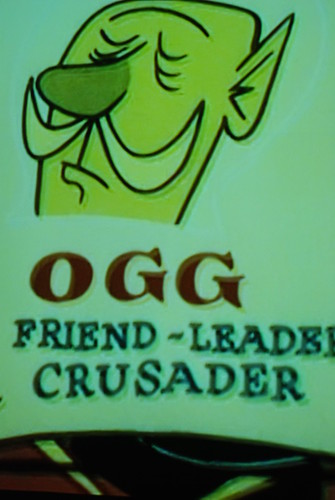
Mars is ruled by a dictator named Ogg. The martians are small yellow hermaphrodites with big noses and space helmets. The poor shlubs are herded by soldiers into a space-age coliseum where Ogg forces them to applaud as they endure his criticisms of problems with martian ground transportation ... shitty fuel, too much friction.
A single martian is sent to Earth to find a solution. The intrepid Martian crashes his saucer into a farm, sets forth into the city, learns about the glorious benefits of petroleum, steals a few library books, and heads back to Mars.
He reveals the truths he's learned to the crowd in the coliseum. The crowd is fueled by the spirit of capitalism and the dictatorship breaks down instantly, to be replaced by the Oil Pioneers, the Oil Explorers, and new management.
We learn that a future with oil and competition is: "Destination Unlimited".
WANT more Babba Zee and the Outraged Spleen of Zion? Try these recent posts:
Georgia is a strategic crossroad for hydrocarbon transit in the Caspian region. The country has experienced significant growth since the new democratic government came into force. The main directions of the energy policy are energy security, diversification of gas supplies, reconstruction of hydropower plants, construction of underground gas storage facilities, attracting foreign investments and privatization.
The South Caucasus gas pipeline and the BTC (Baku-Tbilisi-Ceyhan) pipeline allow oil and gas to flow from Azerbaijan through Georgia to Europe. Over the last decade, $5 billion has been invested by BP and its partners into development of the major oil and gas pipelines that cross Georgia.
Reconstruction work on the Batumi Oil Terminal is now complete and reconstruction of the Poti port is currently underway. Construction of a new, Kulevi Oil Terminal, operated by SOCAR, will be completed this year.
There has been a great deal of interest in developing Georgia's own oil and gas fields. Oil exploration projects are being conducted in East and South-West Georgia. In 2007 several new license blocks were awarded to international oil companies.
Specifically, Frontera's strategy is to seek opportunities in known hydrocarbon-bearing basins around the world where historical geopolitical and/or economic situations may have caused significant oil and gas plays to be overlooked or underdeveloped. Being among the first to enter these markets as they change and emerge from these historical situations is a primary objective in order to capture opportunity. Within this strategy, Frontera's current focus is targeted on exploiting a 'Greater Black Sea' initiative, with a primary focus on its core operations in the country of Georgia.
In 2001 the EBRD took possession of Frontera's stake in the project when the US company failed to repay a $ 60 mm loan from the bank. And year later the EBRD has decided to sell its 30 % stake to the Chinese National Petroleum Company.
On July 26, CNPC President Jiang Jiemin had a talk with visiting Russian Deputy Prime Minister lgor Sechin on reinforcing cooperation between the two countries' energy sector.
Mr. Igor Sechin was visiting China at the invitation of his Chinese counterpart Wang Qishan to launch an energy resources negotiation mechanism in Beijing.
(Beijing, May 30, 2005) - The Beijing Organizing Committee for the Games of the XXIX Olympiad (BOCOG) announces that China National Petroleum Corporation has been selected an official partner of the 2008 Beijing Games after the two parties sign an agreement today.
The agreement entitles China National Petroleum Corporation (CNPC), China's largest producer and supplier of crude oil and natural gas, to provide funding and services to the Beijing Olympic Games, the Beijing Paralympic Games, BOCOG, the Chinese Olympic Committee and the Chinese sports delegations to the 2006 Winter Games in Torino, Italy and the 2008 Games in Beijing. CNC is the eighth company to join the elite club of the Beijing 2008 partners.
The partnership agreement was signed by Wang Wei, BOCOG's executive vice-president and secretary general, and Duan Wende, vice president of CNPC and vice president of the listed PetroChina, at a high-profile ceremony at the Diaoyutai State Guesthouse. Liu Jingmin, vice mayor of Beijing and BOCOG's executive vice-president, and Chen Geng, president of CNPC and chairman of PetroChina, exchanged souvenirs after the document-signing session.
"We are glad to see CNPC participating in the Beijing Olympic Games as an official partner in the category of crude oil and natural gas," Wang Wei said at the signing ceremony, witnessed by senior officials from the State-owned Assets Supervision and Administration Commission of the Chinese State Council, BOCOG, CNPC and representatives from the International Olympic Committee, China's General Administration of Sport and the Chinese Olympic Committee.
[SNIP]
CNPC is one of the world's top 10 oil companies, ranking 52nd on Fortune's Global 500 list in 2004. In China, it is one of the leading companies in the energy sector. For years, CNPC has been the most profitable company in China, and a top contributor to the government's tax revenue.
Cordially thanking the Turkmen leader for finding the time to arrive in Beijing that hosted the Olympic Games and the opportunity of a personal meeting the CNPC Chairman focused on the significance attached by China to co-operation with Turkmenistan which was brought up to a higher level nowadays. Mr. Jiang Jiemin said that the Chinese leadership paid special attention to the project on construction of the Turkmenistan-China gas pipeline of exceptional importance for intensifying intergovernmental collaboration. In this regard the CNPC Chairman said that he was glad to have an opportunity to report the President of Turkmenistan on the progress of this grandiose project and the works to extract oil and establish the relevant infrastructure in the gas fields on the right bank of the Amu Darya River under the Production Sharing Agreement. The Chinese businessmen informed Gurbanguly Berdimuhamedov that the works were carried out and the facilities would be put into service according to schedule. The construction of the section of the pipeline crossing the territory of China had been completed. Mr. Jiang Jiemin said that the gas pipeline from Turkmenistan to the People’s Republic of China would have been constructed by the end of 2009. The capacity of the gas pipeline would be 40 billion cubic metres.
Showing satisfaction at this information Gurbanguly Berdimuhamedov focused on the importance of this project for diversifying the development of Turkmenistan’s fuel and energy sector and exporting energy resources to the world markets as well as with regard to the significance that Turkmenistan attached to enhancing partnership with China, maintaining and developing the traditions of Turkmen-Chinese friendship. The Turkmen leader reaffirmed Turkmenistan’s adherence to the commitments undertaken noting that the country’s profound energy potential guaranteed the success of the agreement on natural gas export to the People’s Republic of China. The results of the audit of hydrocarbon resources carried on by the British company would be another guarantee of Turkmenistan’s competence as a dependable fuel exporter. The President suggested that the Chinese partners would purchase up to 10 billion cubic metres in addition to 30 billion cubic metres as stipulated by the intergovernmental agreement. The Turkmen leader also called for expanding co-operation with CNPC by implementing new projects, particularly construction gas processing facilities.
The Chinese partners showed keen interests in the President’s proposals and expressed sincere gratitude to the Turkmen leader for the constructive approach to co-operation. Mr. Jiang Jiemin said that the Turkmen leader’s initiatives would be taken into consideration and specified during the talks with the fuel and energy departments of Turkmenistan.
President Vladimir Putin scored a victory for access to Turkmen gas on Saturday, winning approval for a direct pipeline around the Caspian in a major setback to U.S.-backed plans for an alternative route that would bypass Russia.
The new pipeline is due to run from western Turkmenistan along the Caspian shore, pumping billions of cubic meters of gas through Kazakhstan before entering Russia, from where it will likely be exported at great profit.
A triumphant Putin announced the deal after a meeting with Turkmen President Gurbanguly Berdymukhammedov and Kazakh President Nursultan Nazarbayev in the Caspian port of Turkmenbashi.
The deal serves a big blow to U.S. and European Union interests. Washington and Brussels have been lobbying hard for a pipeline that would send Turkmen gas to Europe under the Caspian Sea, cutting Moscow out of the picture.
The new pipeline will come as a relief for Gazprom, which relies on Turkmen gas to fulfill its supply contracts as production at home stagnates and energy demand across Europe grows.
Competition for Turkmen gas reserves, estimated by BP's Statistical Review to stand at 2.9 trillion cubic meters, has intensified since the death of President Saparmurat Niyazov in December.
An official agreement would be signed by July, and construction could begin within one year of its signing, Putin said in remarks posted on the Kremlin web site.
Under an agreement signed with Niyazov in 2003, Turkmenistan was committed to ship 50 billion cubic meters of gas to Russia next year, a number due to rise to 80 bcm by the time the agreement runs out in 2028.
Putin said the new pipeline would pump at least 20 bcm of gas annually by 2012, and Industry and Energy Minister Viktor Khristenko said in Turkmenbashi that the number could eventually reach 30 bcm, Itar-Tass reported.
Officials failed to indicate how much it would cost to build the pipeline, but Itar-Tass cited 2003 estimates placing construction costs at $1 billion. The true cost of the pipeline would likely run much higher, as the prices of materials such as steel have risen drastically in recent years.
Russia, through state-run Gazprom, already imports about 42 bcm of gas per year from Turkmenistan at a price of $100 per 1,000 cubic meters.
It then exports the gas to Europe for an average price of $250 per 1,000 cubic meters, reaping tremendous profit while using domestic reserves to fulfill cheaper supply contracts at home.
Gazprom CEO Alexei Miller, who was accompanying Putin on his trip, said the $100 price for Turkmen gas would last through 2009 and that a new price would be negotiated by July of that year.
The three presidents said they would also expand the capacity of an existing pipeline that currently pumps Turkmen gas to Russia through Kazakhstan and Uzbekistan to 90 bcm. Uzbek President Islam Karimov signed off on the deal from Tashkent before the Turkmenbashi summit, Putin said.
Niyazov won key concessions from Putin on oil transit during talks in the Kazakh capital, Astana, on Thursday, prompting some analysts to speculate on a possible trade-off for Kazakhstan's approval of the Caspian pipeline project.
Putin said he would drop longstanding objections to expansion of the Caspian Pipeline Consortium, which carries oil from Kazakhstan's Tengiz field to the Russian Black Sea port of Novorossiisk. He also agreed to Kazakhstan's participation in the Russian-controlled pipeline from the Bulgarian Black Sea port of Burgas to Alexandroupolis on the Greek Adriatic.
"We will transport [oil and gas] by whichever route is profitable," Nazarbayev said in Turkmenbashi, news agencies reported.
Putin said the Turkmen leadership had initiated plans for the new Russia-backed Caspian pipeline. "We are opening the Caspian route at the request of Turkmenistan," Putin said, The Associated Press reported.
No other countries would be invited to participate in the pipeline's construction, he added. "It's enough to have three countries," he said.
The deal will likely further put off discussion of a trans-Caspian pipeline that would ship Turkmen gas under the Caspian Sea to Baku. Azerbaijan and then on to Europe, Russian officials and analysts said.
"Existing technical, legal, environmental and other risks relating to the trans-Caspian project are so great that it would be impossible to find an investor," Khristenko said, remarks posted on the Kremlin web site showed.
"Unless this is a political project, and then it does not matter what would be inside the pipeline as long as it exists," he said.
Berdymukhammedov said consideration of the alternative route was still "on the table," Russian news agencies reported.
The Turkmen leadership has promised to build a gas pipeline to China, and Berdymukhammedov said the country was also considering routes to Afghanistan and India.
"Don't worry, there is enough [gas]," he said, Reuters reported.
Turkmenistan, largely closed to the outside world during Niyazov's rule, has refused to allow any independent assessment of its gas reserves and claims closer to 10 times the figure put forward by BP.
"If these claims are substantiated and if the Turkmens find investors to produce this gas, the possibility of the trans-Caspian pipeline remains on the table," said Valery Nesterov, an analyst at Troika Dialog.
Both the Odessa-Brody pipeline in Ukraine and the Nabucco pipeline, planned to carry gas from the Caspian to Austria, were approved despite Russian objections, he noted.
The EU, supported by the United States, has been pushing to reduce its reliance on Russian gas amid concerns over Moscow's ability to wield its energy power for political ends.
Nesterov said politics would win out. "If politicians really have a strong desire to get more gas that would bypass Russia, they could offer to incur some financial losses and risks," he said.
Putin moved to reassure critics on Saturday, saying: "We take our responsibility in the world energy supply very seriously."
Putin wrapped up his three-day visit to Turkmenistan on Sunday, flying to the Caspian port of Aktau, the center of Kazakhstan's booming oil industry. He was due to hold further talks with Nazarbayev before flying back to Moscow on Tuesday. (The Moscow Times 14.v.07)There's about 666 TA DA's in here somewhere mah Ferals..... also notice in the below how they are only bombing the pipeline that British Petroleum is the major owner of:
News reports indicate that Russia may have tried to bomb the Baku-Tbilisi-Ceyhan pipeline, which runs through Georgia. If so, the bombs missed, and flow of oil through the pipeline was not interrupted. The BTC pipeline runs from the Caspian Sea to the Mediterranean coast of Turkey; note Russia to the north and Iran to the south:
The BTC pipeline runs through Georgia, well south of South Ossetia:
Think back seven years to when President Bush delivered the same message that Americans are now demanding of Congress: "Drill, Drill, Drill"?
He was ridiculed and called a greedy oilman by the same cheerleaders that run interference for Barack Obama and congressional Democrats now: the mainstream press.
Red Planet Cartoons has done an invaluable service, both in producing the cartoon above AND reproducing the quote below from a 2001 Time article on energy policy.
In May, convinced the nation was terrified of going California and hungering for a steak-and-eggs energy plan, Bush sold his plan as an aggressive drill-and-dig, anti-regulatory prescription to shoo away the tree-huggers and get the nation — and the economy — humming again.
Two months later, a New York Times/CBS poll released last week found that not only do two-thirds of the nation think Bush and Cheney are too beholden to oil companies, 60 percent think the pair made the whole energy crisis up.
And why not? Energy prices are falling, both in the market and at the pump, and Alan Greenspan, in a post-rate-cut speech Thursday in Chicago, said energy-price inflation was the furthest thing from his mind. Time magazine: The GOP Try on Jimmy Carter's Sweater June 29m 2001
This is a little reminder: whatever Bush would have done would have made little difference to the lock-step liberals at Time: he would have been wrong and paralyzing his actions would've been called for.
RPC then fast-forwards to 2008:
"…I’ll remind people it took us a while to get into the energy situation we’re in and it’s going to take us a while to get out of it. But one thing is for certain here in the United States, that we can help alleviate shortages by drilling for oil and gas in our own country — something I’ve been advocating ever since I’ve been the President." --President Bush Discusses 2008 G8 Summit
Red Planet--as well as Bush--could have, at that point, yelled, "GOTCHA!" at all those who have been placing roadblocks in the way of finding and extracting energy in the U.S.
It would have felt good--but it wouldn't bring the price of gasoline down.
Diesel fuel produced by genetically-engineered bugs.
Several Silicon Valley companies are already genetically altering microbes and small organisms--bugs, so to speak--so that they produce something for nothing.
The something? How about petroleum products.
The nothing? How about agricultural waste--wood chips or straw or other biomass.
The organisms eat the waste products and excrete crude oil.
“Ten years ago I could never have imagined I’d be doing this,” says Greg Pal, 33, a former software executive, as he squints into the late afternoon Californian sun. “I mean, this is essentially agriculture, right? But the people I talk to – especially the ones coming out of business school – this is the one hot area everyone wants to get into.”
This sounds far-fetched, but the bugs are producing crude right now. In about a month, the experimental microbes will have produced enough oil to fill the first gas tank with something engineers call "renewable petroleum".
Mr Pal is a senior director of LS9, one of several companies in or near Silicon Valley that have spurned traditional high-tech activities such as software and networking and embarked instead on an extraordinary race to make $140-a-barrel oil (£70) from Saudi Arabia obsolete. “All of us here – everyone in this company and in this industry, are aware of the urgency,” Mr Pal says.
What is most remarkable about what they are doing is that instead of trying to reengineer the global economy – as is required, for example, for the use of hydrogen fuel – they are trying to make a product that is interchangeable with oil. The company claims that this “Oil 2.0” will not only be renewable but also carbon negative – meaning that the carbon it emits will be less than that sucked from the atmosphere by the raw materials from which it is made.
Besides making Saudi oil a thing of the past, it will also render Al Gore's dreams of taxing the world back into the Stone Age obsolete.
Also made obsolete will be the need for heavily-subsidized ethanol, which has created food shortages in some countries and raised the price of foodstuffs in the USA, due to corn being bought up by subsidized ethanol makers. The "energy-intensive final process of distillation" used in the manufacture of ethanol is "virtually eliminated because the bugs excrete a substance that is almost pump-ready."
Crude oil is only a "few molecular stages removed from the fatty acids normally excreted by yeast or E. coli during fermentation." The microbes can feed on just about anything, "as long as it can be broken down into sugars.
LS9 has already convinced one oil industry veteran of its plan: Bob Walsh, 50, who now serves as the firm’s president after a 26-year career at Shell, most recently running European supply operations in London. “How many times in your life do you get the opportunity to grow a multi-billion-dollar company?” he asks. It is a bold statement from a man who works in a glorified cubicle in a San Francisco industrial estate for a company that describes itself as being “prerevenue”.
Inside LS9’s cluttered laboratory – funded by $20 million of start-up capital from investors including Vinod Khosla, the Indian-American entrepreneur who co-founded Sun Micro-systems – Mr Pal explains that LS9’s bugs are single-cell organisms, each a fraction of a billionth the size of an ant. They start out as industrial yeast or nonpathogenic strains of E. coli, but LS9 modifies them by custom-de-signing their DNA. “Five to seven years ago, that process would have taken months and cost hundreds of thousands of dollars,” he says. “Now it can take weeks and cost maybe $20,000.”
The company is not interested in using corn as feedstock, given the much-publicised problems created by using food crops for fuel, such as the tortilla inflation that recently caused food riots in Mexico City. Instead, different types of agricultural waste will be used according to whatever makes sense for the local climate and economy: wheat straw in California, for example, or woodchips in the South.
When will the microbe-produced oil be ready to fuel cars? Or rather, when will companies, such as LS9, be ready to mass produce "renewable petroleum"?
Right now, it looks like the start of anything resembling a large-scale project is about three years down the road.
The closest that LS9 has come to mass production is a 1,000-litre fermenting machine, which looks like a large stainless-steel jar, next to a wardrobe-sized computer connected by a tangle of cables and tubes. It has not yet been plugged in. The machine produces the equivalent of one barrel a week and takes up 40 sq ft of floor space.
However, to substitute America’s weekly oil consumption of 143 million barrels, you would need a facility that covered about 205 square miles, an area roughly the size of Chicago.
That is the main problem: although LS9 can produce its bug fuel in laboratory beakers, it has no idea whether it will be able produce the same results on a nationwide or even global scale.
“Our plan is to have a demonstration-scale plant operational by 2010 and, in parallel, we’ll be working on the design and construction of a commercial-scale facility to open in 2011,” says Mr Pal, adding that if LS9 used Brazilian sugar cane as its feedstock, its fuel would probably cost about $50 a barrel.
When oil is $50 a barrel, it isn't attractive to work on alternatives. When oil hovers around the $140-a-barrel price, alternatives suddenly become attractive.
The ultimate end result may not be exactly something for nothing--companies, such as LS9, and their investors need to be compensated for their efforts and risk--but it's close.
As long as PETA doesn't get involved, the well-fed bugs will just be happy to be there.
"If you end up freezing (Venezuelan assets) and it harms us, we're going to harm you," Chavez said. "Do you know how? We aren't going to send oil to the United States. Take note, Mr. Bush, Mr. Danger."
Hugo Chavez shows off a new source of fiber
Venezuelan president Hugo Chavez is back to what he does best: threatening people when events don't go his way.
This time, he threatened to cut off oil exports to the USA if courts rule against his seizing Exxon Mobil assets and freeze Venezuelan assets in retaliation.
Chavez threatened yesterday to cut off oil sales to the United States if Exxon Mobil Corp wins court judgments to seize Venezuelan assets valued in the billions of dollars.
Chavez issued his threats as Exxon Mobil moved through the legal system in an effort to try and recoup the billions it lost when Chavez seized Exxon Mobil assets in Venezuela when he nationalized an Exxon Mobil oil project.
Exxon Mobil has gone after the assets of state oil company Petroleos de Venezuela SA in U.S., British and Dutch courts.
A British court has issued an injunction "freezing" as much as $12 billion in assets.
"If you end up freezing (Venezuelan assets) and it harms us, we're going to harm you," Chavez said. "Do you know how? We aren't going to send oil to the United States. Take note, Mr. Bush, Mr. Danger."
"I speak to the U.S. empire, because that's the master: continue and you will see that we won't sent one drop of oil to the empire of the United States," Chavez said during his weekly radio and television program, "Hello, President."
"The outlaws of Exxon Mobil will never again rob us," Chavez said, accusing the Irving, Texas-based oil company of acting in concert with Washington.
Chavez has continually threatened to cut off U.S. oil imports from his nation if the U.S. attempts to oust him.
"If the economic war continues against Venezuela, the price of oil is going to reach $200 (a barrel) and Venezuela will join the economic war," Chavez said. "And more than one country is willing to accompany us in the economic war."
So Hugo Chavez threatens the United States with war?
At present, the Venezuelan strongman is aided and abetted by those in Congress, including Senator John McCain, who limit the drilling for U.S. oil in the United States.
Of course, the American president has little control over the U.S. legal system, one lesson in American civics that is probably lost on Chavez, who has steadily consolidated his power over his countrymen.
As more Venezuelans mount protests against his anti-democratic tactics, Chavez has turned more and more to a foreign bogeyman to try and rally support at home: the U.S. and president George Bush.
However, Chavez might do well to recall an old chess maxim.
Former commander of U.S. forces in the Middle East, Army General John Abizaid, says the U.S. conflict in the Middle East could take up to 25-50 years to resolve and that America's been lucky not to have had another 9/11 incident.
The AP quotes Abizaid, speaking to students at Carnegie-Mellon University in Pittsburgh:
"It's going to be hard, it's going to be long, it's going to be arduous, dangerous, bloody and expensive," Abizaid said Wednesday. "But, on the other hand, I do believe it's workable, provided that we have conversations like this and understand the dynamics that are at play out there.
"And it's not so one-dimensional as to be all-Iraq all the time," he said.
Abizaid also spoke about U.S. interests--and the number one U.S. interest in the Persian Gulf area is oil.
"I'm not saying this is a war for oil, but I am saying that oil fuels an awful lot of geopolitical moves that political powers may have there," Abizaid said. "And it is absolutely essential that we in the United States of America figure out how, in the long run, to lessen our dependency on foreign energy."
It's not hard to see that this story will be another brick in the wall by the owners of Trendy Left shops selling "No Blood for Oil" T-shirts. John Abisaid is a general; the general said "oil". The lightbulb will go off and another T-shirt, bearing the likeness of the general and a slogan such as, "I need a fill-up--Kill another kid", will be born.
The fact remains that unless Americans wants to park their cars or spend $15 for a gallon of gasoline, oil is an important component of the U.S. economy and to its way of life. And the Middle East does have plenty of oil. It may be their only exportable commodity--outside of hate and extremists bent on avenging the ills of the 12th Century.